Karl Marx theorized that the social structures of a society were determined by its economic structures. The concept he developed, which he named “the materialist conception of history”, is today known as historical materialism. In brief, Marx proposed sociopolitical change proceeded as follows:
Technological innovations unlock a new, more effective mode of production.
Society reorganizes itself around this mode of production.
In his own time, Marx was chiefly repudiating the notion that progress in philosophical ideals was the primary catalyst of sociopolitical progress. He thus relegated Enlightenment thinkers such as Locke and Voltaire to supporting roles in the revolutions of the 18th and 19th centuries, and elevated economic changes to the narrative center. In so doing, he sought to show that history’s broad arcs could be predicted scientifically, as the natural consequences of shifting economic conditions.
However, Marx’s preoccupation with economic forces led to a fatal misstep in his incipient science of history. I propose to show that historical sociopolitical structures have been determined primarily by the military structures of a society rather than by its economic structures. While it is true that the most economically productive social structures are often also the most militarily effective structures, this is not always the case. Indeed history provides some interesting counterexamples. These counterexamples and the theory they elucidate can help us understand our own times, and can point to likely future sociopolitical developments.
I thus propose a new conception of history I dub “historical militarism.” This conception of history seeks to explain sociopolitical changes in terms of shifts in military advantage under changing technological conditions. These shifts can occur either between societies or within factions of a society. In this conception, Marx’s narrative of change is replaced by a new narrative:
Technological innovations unlock a new, more effective means of military organization.
Society reorganizes itself around this military organization.
Notes:
Greek city states: Why city states? Defense > Offense, no ability to attack fortified cities / successfully siege. Athens democracy? Sea power, rowers. Sparta aristocracy? Land power, professional warrior caste.
Feudal society to democratic republics: Shift from expensive knights to muskets
There’s a contemporary assumption that the goal of progress (whether technological, political, or otherwise) is to make people happier. Steve Pinker defends progress on the grounds that economic advances have made the world a better place than it has ever been. In 1930, John Maynard Keynes predicted everyone would be working less than 15 hour workweeks within a few short decades. And we’ve all heard the aphorism that “the arc of the moral universe is long, but it bends towards justice.”
By the end of this post, I hope to convince you that progress as we know it has absolutely nothing to do with the improvement of the human condition.
“Progress”
Before going further, it’s worth having a working definition of progress, since definitions matter. Googling the noun turns up: “forward movement toward a destination.” To examine social progress is to examine not only how societies adapt and move forward, but also the destination of this movement and what drives it.
The State of Nature
To illustrate the perils of progress I think it’s best to start with the world’s first revolution: the transition from hunter-gatherer to agricultural societies. From the standpoint of the human condition, this transition was a major disaster. Farmers worked longer, suffered from more diseases, and were so malnourished that they were actually 6 inches shorter than their hunter-gatherer contemporaries (you might be shocked to learn this, I certainly was the first time I heard it).
So if the prognosis for our early agriculturalist ancestors was so grim, why did they take up farming?
The answer is that when we think of progress, an individual human life is not the right unit of selection. Instead, we must understand that the ancient world was organized into small groups of humans who were largely locked into intergroup competition. And while farming might not be a great strategy if you want to live the good life, it turns out to be a great strategy if you’d like to massacre your neighboring tribes.
The Agricultural War Machine
What made agriculture such an effective military advancement? First, cultivation of the land allowed a much higher population density. Secondly, agricultural surpluses freed up a percentage of the population to specialize in metalworking and other crafts. The larger population density and proliferation of specialized trades led to the creation of larger, more complex social structures. And a portion of the greater populace and economic output of these societies was freed to be turned towards territorial expansion and warfare.
Thus any ancient peoples who were able to manage the transition to the plow, whatever their initial intention, soon found themselves capable of militarily dominating their hunter-gatherer neighbors. Neighboring tribes were forced to either adapt or succumb to the territorial expansion of the growing farming communities. The only exceptions to this rule are those peoples who dwelt in backwater lands unsuited to the agriculture of the time. Some of these peoples found other means of obtaining military success (most notably the pastoralists of the Eurasian steppe, who were able to compete with agricultural societies by weaponizing the horse).
The Industrial Meat Grinder and the A-Bomb
Whether you believe this story of the Neolithic Revolution or not, there are various other candidates for technological and political innovations that were detrimental to human flourishing. The industrial revolution of the 19th century resulted in the longest working hours of all time. The atomic bomb might still be the black ball that wipes out humanity. Or maybe consider that depression rates amongst teens has risen dramatically over the past decade, roughly coinciding with the rise of social media.
If progress and human flourishing are not inextricably linked, then what is progress and what drives it? Let’s derive some general rules.
The Progress Equation
When we look at history and observe how societies have progressed historically, we are led to a few conclusions:
There have historically been a large number of competing societies.
Competition between these societies happened along demographic, economic, and military dimensions.
Technological, economic, and political progress was the mechanism by which a society improved its competitiveness vis-à-vis other societies.
Using these, we can write down the Progress Equation:
Progress = People x Production x Power
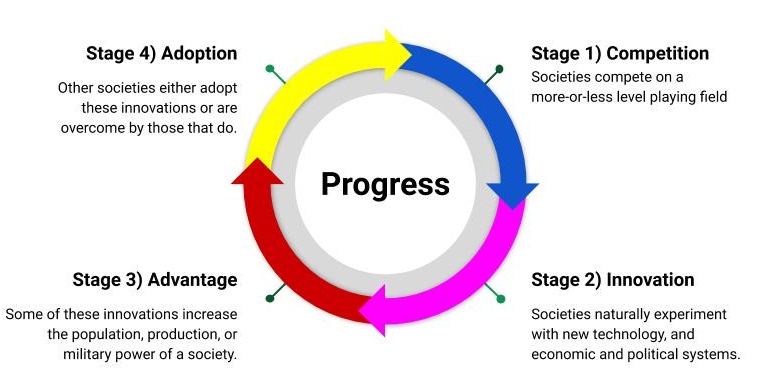
That is, any innovation that tends to increase the population, economic output, or military capabilities of a society will quickly spread. Neighboring societies will either adopt the innovation or, after enough of a gap has opened between the two societies, succumb to the innovating society. The forward march of these innovations is the driving force behind social progress.
We can therefore view the march of progress as a loop:
Since the advantage of any particular innovation is neutralized over time, long-lasting societies adopt systems that allow them to iterate over the progress loop more effectively than their neighbors. Strategies for a society can include:
Increasing their rate of adoption of their neighbors’ innovations
Decreasing their neighbors’ rate of innovation
Decreasing their neighbors’ rate of adoption of their innovations
Implications for the Future
We happen to live in a relatively prosperous time. Economic output is high, and working hours have dropped from their 19th century peak. There has not been a total war between two major powers in over 70 years. But when the Progress Equation is stripped bare, it’s easy to imagine innovations that could be detrimental to the human condition while simultaneously increasing the population, productivity, or military power of a society. Here’s an example from category to illustrate, I’m sure you could think of many more:
Productivity Pills: A society develops a technology that allows the human brain to work productively >20 hours a day (as opposed to the ~4 hours of productive knowledge work currently achievable). Societies that protect their leisure time with strong labor laws quickly fall behind.
As long as a large number of independent societies exist, competition via people, production, and power seems inevitable. If one society was able to gain an overwhelming advantage over all the others, it could dictate the rules of competition and ameliorate its worst effects. More palatably, societies could band together to mutually impose such rules on themselves. The UN is an attempt at this.
However, enforcement of such systems is always a problem. Every player in the game has the incentive to defect, or at least to bend the rules as much as possible. Historically, pacts of this nature have not fared well. But maybe we could do better this time.
If we don’t, we may be doomed to perpetual progress.

 Revenge of Vercingetorix